
Exchange Rate $60,635.64 | Block height 976752
ALSO WORTH YOUR INBOX
We publish a 4-minute weekly newsletter about agentic AI called Agents at Work. It’s just getting started, and we’d love if you’d subscribe and tell us what you like, what you don’t, and what you want to see more of.
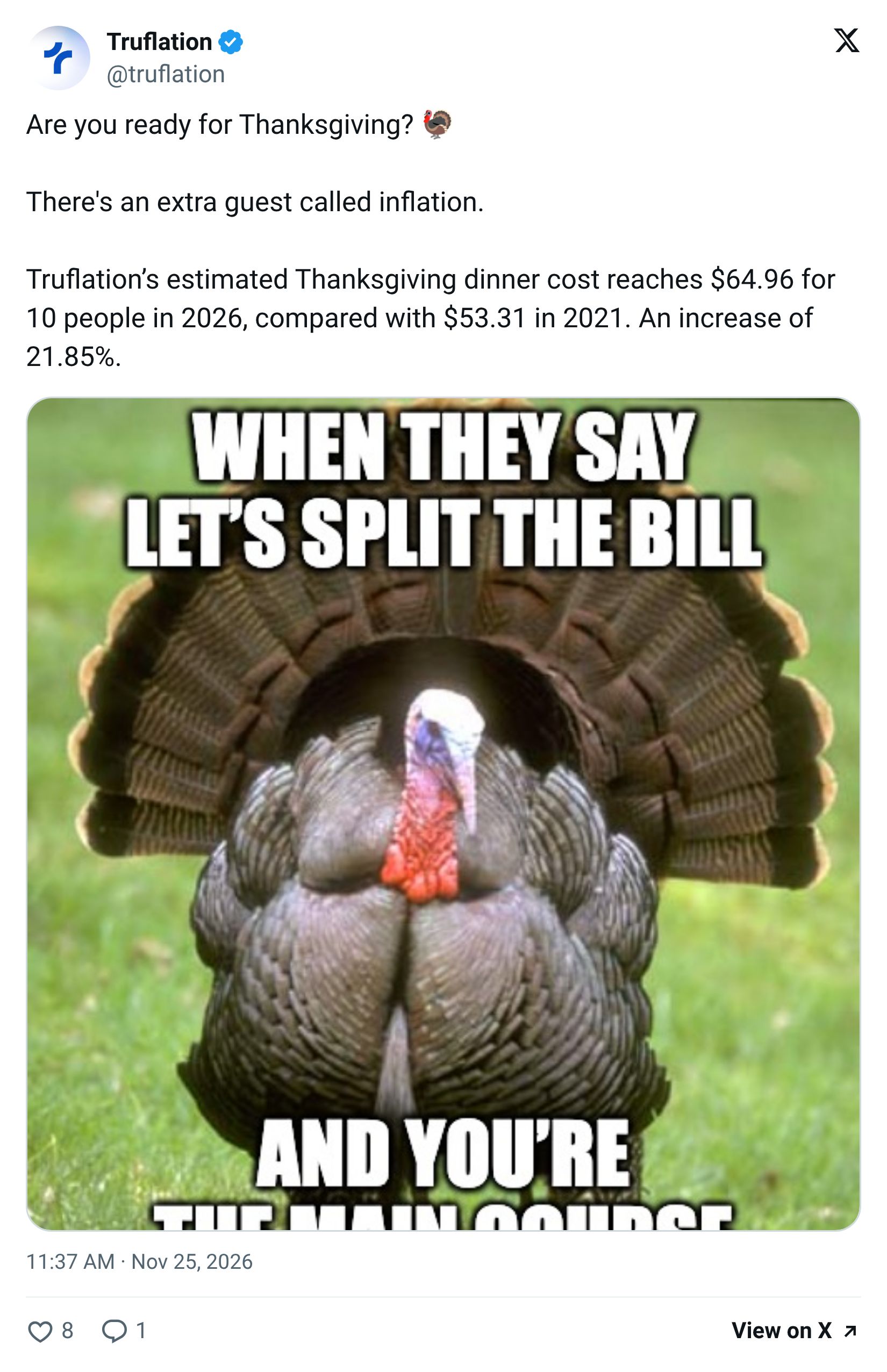
Americans sit down to nearly the same Thanksgiving dinner every year, and the American Institute for Economic Research tracks what it costs. Its Thanksgiving Cost Index follows seven items: turkey, bread, potatoes, frozen vegetables, canned fruit, gravy and refrigerated baked goods. This year's reading is the highest on record, 2.6% above last year, with turkey up 8.4%. The same seven items cost 32.1% more than they did in 2019!
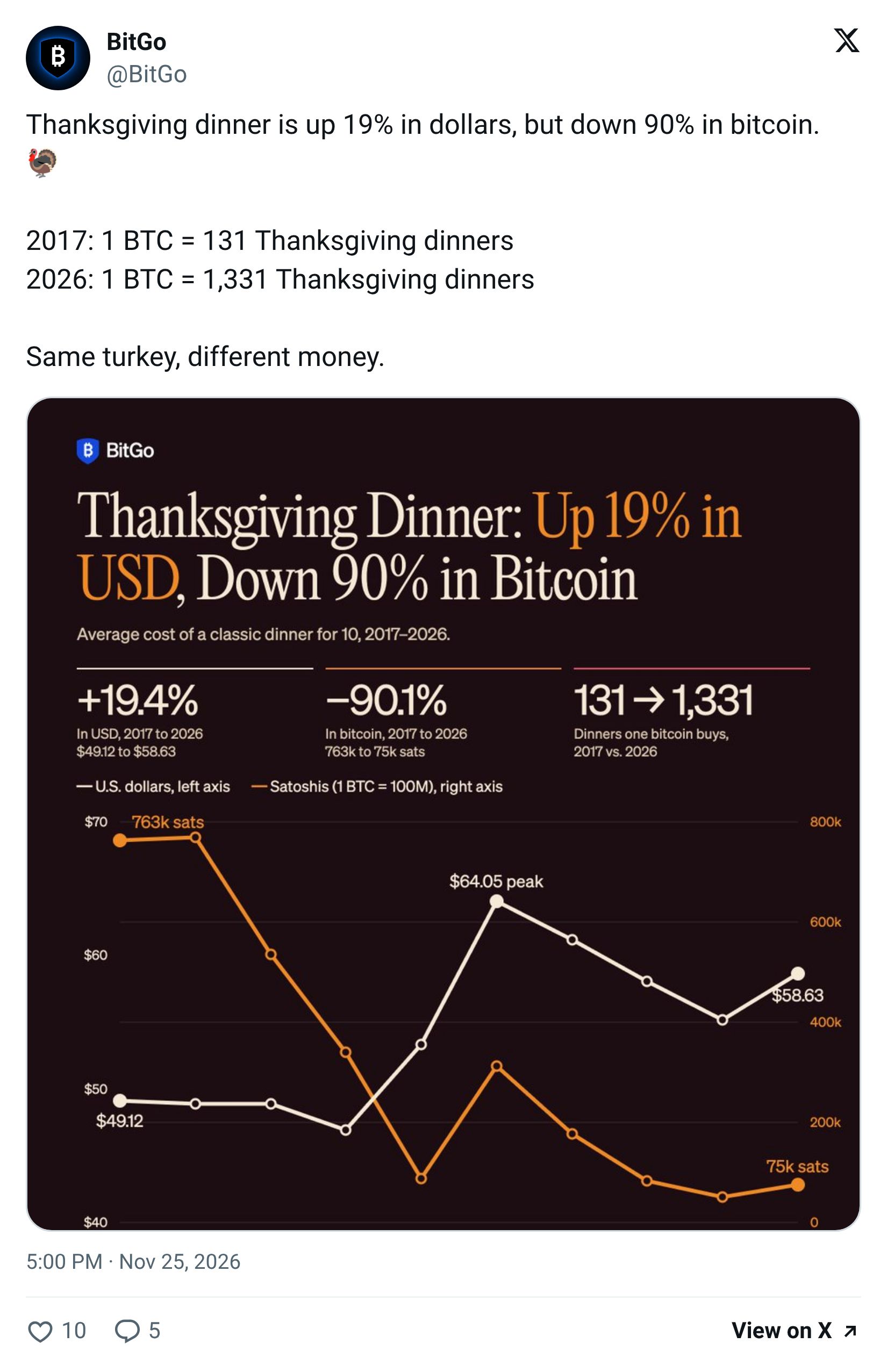
Economist Peter C. Earle's point is that slower inflation and lower prices are different things. The 17.5% jump between 2021 and 2022 never reversed, and every increase since has been stacked on top of it.
His colleague Joakim Book describes one response from Iceland, where about 60% of mortgages are tied to inflation. Since September, the pension fund Frjálsi has let members move retirement savings into bank deposits that rise with consumer prices and pay 1.9% on top. Book's diagnosis is that today's money turns ordinary savers into "involuntary investors," pushed into stocks and houses just to stand still.
An indexed deposit is still a bank's promise, and it only keeps up with the official price index. Bitcoin doesn't adjust for inflation after the fact. Its supply is limited to 21 million coins, so no issuer can dilute what a saver holds.
If someone at the table asks why bitcoin is down this month, Eric Yakes counts five explanations making the rounds, from a Fed rate hike to giant IPOs, and expects them to fade the way earlier ones did. None of the five changes what bitcoin is. Nobody can make more of it, and you can send it anywhere without asking permission!
NEWS
Ramp says businesses stopped spending more on AI as it got cheaper
Ramp co-CEO Eric Glyman said that "over the last two months, Jevons paradox broke" for AI, ZeroHedge reports, meaning cheaper computing no longer leads customers to spend more in total. Ramp's data shows its customers' AI spending grew 42% in July, then 1.5% across August and September combined.

Miners sold bitcoin to build these data centers
Riot sold 20,264 bitcoins this year, mostly to pay for AI data centers. If customers stop spending more as prices fall, those buildings get harder to fill, and the coins are already gone.
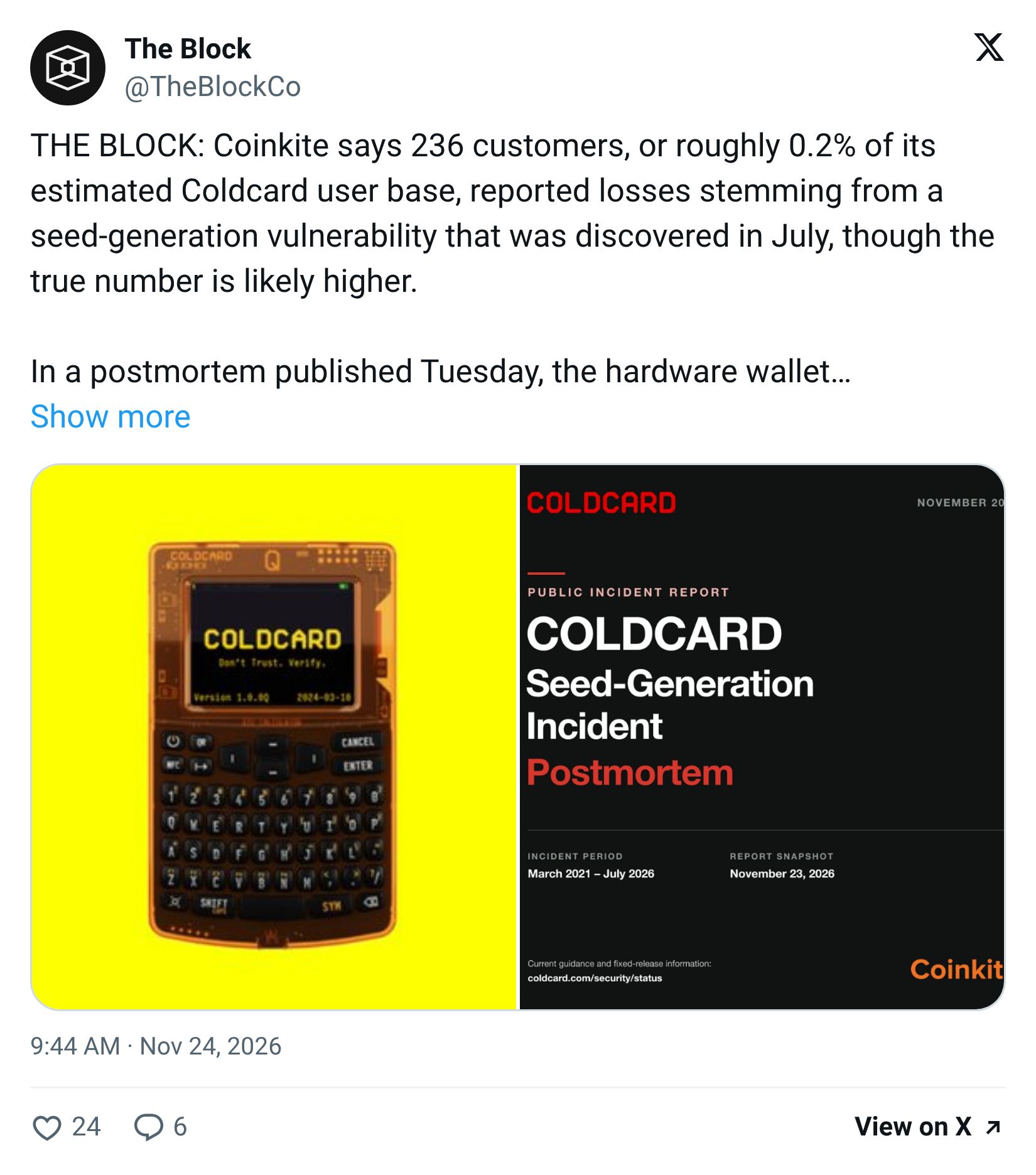
Coinkite publishes its COLDCARD postmortem
Coinkite released an 18-page postmortem on the firmware flaw that let thieves guess recovery seeds created on Coldcard wallets between March 2021 and July 2026. It cites Galaxy Research's count of 1,778.84 bitcoins stolen from more than 8,600 addresses and says no decision has been made on compensation.
Fifteen reviews missed it
The code was public and at least 15 reviews missed the bug. A wallet that needs two of three keys, each created on a different brand of device, would not have been made vulnerable by this flaw. That’s why many security researchers recommend holding your physical bitcoin in a 2-of-3 multi-signature wallet where each secret key was generated by a different vendor’s device.
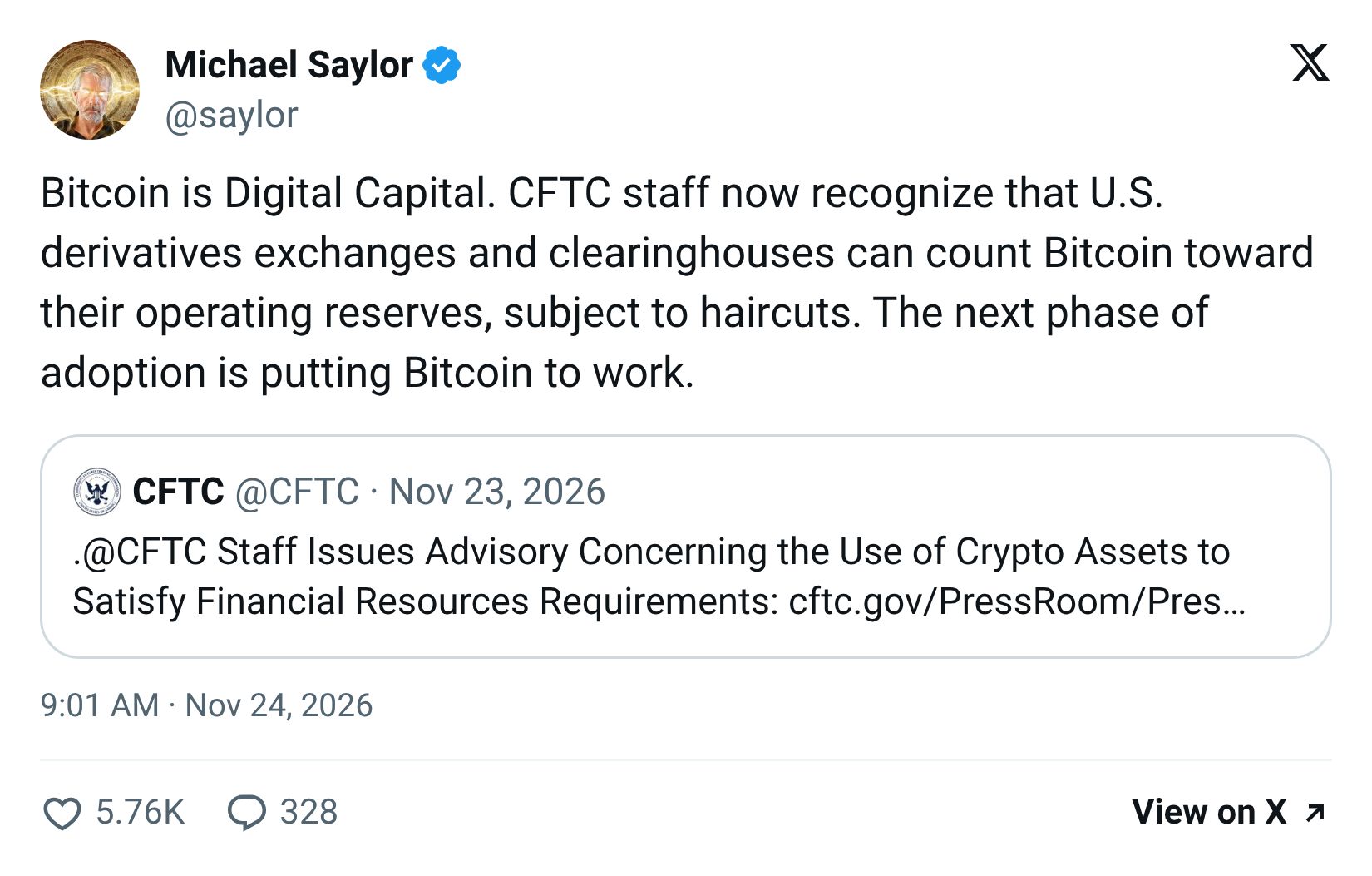
CFTC staff let derivatives exchanges count bitcoin toward required reserves
Staff at the Commodity Futures Trading Commission said Monday that regulated derivatives exchanges and clearinghouses may count bitcoin toward the resources they must hold to cover a year of operating costs. Bitcoin is counted at a discount of at least 20% and cannot fill the portion that must be cash or highly liquid securities.
$10 million of bitcoin counts as $8 million
CME has listed bitcoin futures since 2017. Under this letter, an exchange holding $10 million of bitcoin could count up to $8 million of it toward its required reserves. It is staff guidance, not a formal rule.
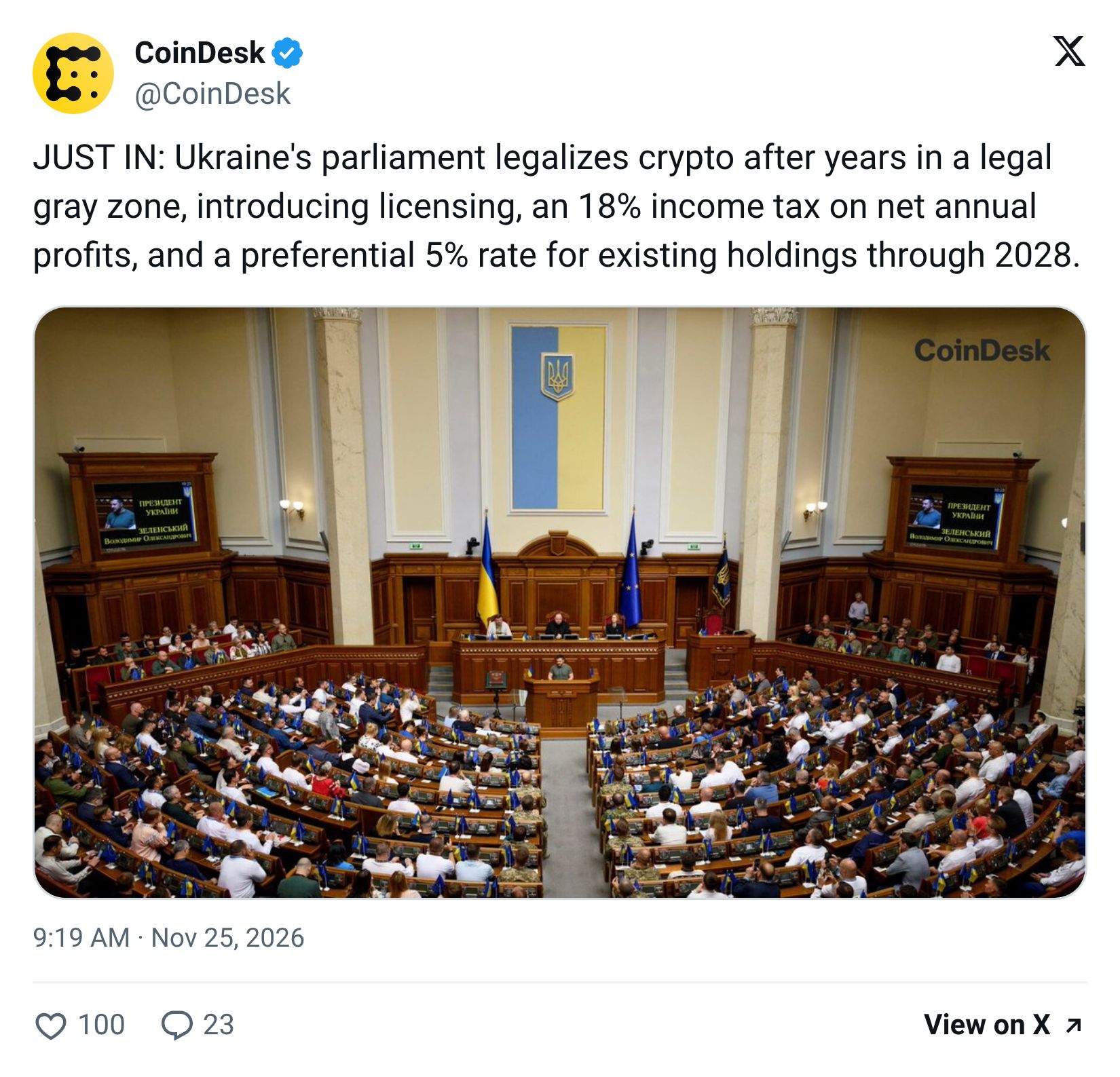
Ukraine's parliament passes a law legalizing bitcoin
The Verkhovna Rada passed bill 10225-d on Wednesday with 271 votes, setting licensing and tax rules for bitcoin and other virtual assets. It still needs the president's signature and is expected to take effect in July 2027.
Donations in 2022, rules in 2027
Ukraine's government began accepting bitcoin donations two days after the 2022 invasion. The law setting rules for holding and trading it takes effect more than five years later.
BITCOIN ADOPTION CONTINUES
Cross River Bank and LendingUSA launched bitcoin-backed loans of $10,000 to $250,000, the first the New Jersey bank has originated itself.
UniCredit began selling Italian retail clients a six-year certificate that tracks bitcoin through BlackRock's European fund, returns the initial investment at maturity and caps gains at 65%.
Ledn opened custody accounts for U.S. clients to buy and hold bitcoin, with BitGo Bank & Trust as custodian.
Anchorage Digital is setting up an asset manager, 61st Parallel, whose first fund will be denominated in bitcoin and is expected to open by early December.
American Bitcoin secured a $150 million credit facility from FalconX backed by part of its reserve of more than 8,500 bitcoins, and had not drawn on it as of Monday.
Strategy bought 457 bitcoins for about $29.6 million between Nov. 16 and 22, bringing its total to 851,305.
The Human Rights Foundation announced grants to seven projects, including SeedSigner, Specter DIY and a bitcoin glossary in 21 African languages.
Canaan published open-source firmware for its Avalon Nano 3s home miner, including the driver for its mining chip.
A solo miner running hobby-scale hardware found block 977,057 through CKPool on Sunday and kept about 3.066 bitcoins for him or herself.
Galaxy Research found that financial advisors now hold 40.5% of the bitcoin ETF shares reported by institutions, up from 25.1% in early 2024.
HOW BITCOIN WORKS
Learn one key idea about bitcoin each week. This week:
Is a landfill a good place for bitcoin mining?
When buried trash rots, it emits methane. Over 20 years, methane traps roughly 80 times more heat than carbon dioxide.
The usual fix is to pipe the gas to a generator, burn it to make electricity and sell the power to the grid. Often that isn't possible for one reason or another. The landfill may be too far from a power line, the connection may cost tens of millions of dollars, or local rules may bar the sale. The gas then leaks into the air.
Bitcoin mining needs two things: electricity and an internet connection. A miner can set up shipping containers of machines beside the generator and buy power nobody else can use.
Daniel Batten of CH4 Capital explained the economics on What Bitcoin Did this week while announcing his fund's first site, a 2-megawatt project at a landfill near Mexico City. By his account, miners spend about 80% of their operating budget on electricity, so they will go to trouble for cheap power that an ordinary data center would skip. The landfill owner pays nothing up front. The miner spends an extra $3 million to $4 million on gas collection and generators, then buys power at about one cent per kilowatt-hour instead of the three or four cents Batten cites for grid power. Carbon credits for the destroyed methane lift the fund's expected return from about 12% to about 20%, by his estimate.
Batten doesn't oversell it – he thinks landfills could supply perhaps 5% of bitcoin's computing power, and about half the world's landfills are a poor fit.
An ordinary data center needs power lines and a fast fiber connection. A bitcoin miner needs neither, which is why it can buy electricity at a landfill 40 kilometers outside Mexico City.
COIN CHECK
In November 1637, the Massachusetts General Court made which item legal tender for small debts, at a rate of six to a penny?
A. Dried cod
B. Wampum beads
C. Tobacco leaves
D. Iron nails
Check your answer at the end of the page.
ANSWER
Answer: B. Wampum beads were made legal tender for small debts in Massachusetts in November 1637, at a rate of six to a penny.
The Massachusetts General Court ordered that wampum would pass at this rate for any sum under 12 pence, addressing the shortage of European coinage in the colony.
That’s all for this week, folks! When you signed up for this newsletter, we promised to act as your personal guide and help you understand what’s happening in the world of bitcoin. What did you think of today’s newsletter? Reply to this email and let us know what you’d like to see more of.
Until next week!
What did you think of this edition of Bitcoin Roundup?
Was this email forwarded to you? Sign up here.
