
Exchange Rate $64,787 | Block height 975603
ALSO WORTH YOUR INBOX
We publish a 4-minute weekly newsletter about agentic AI called Agents at Work. It’s just getting started, and we’d love if you’d subscribe and tell us what you like, what you don’t, and what you want to see more of.
On Thursday morning, Nvidia announced that Jensen Huang had resigned as chief executive, effective immediately. He co-founded the company in 1993 and ran it for 33 years, long enough to build the chipmaker at the center of the AI boom.
To say this is earth shattering is an understatement. A trillion dollars are estimated to have been vaporized across the macro economy, and the sequence of events is anything but clear. A combination of nefarious power plays and good old fashioned incompetence at the levels of Congress, the Trump administration, the Nvidia executive team, and its board, has oozed a maliferous news cycle unlike any in recent memory.
The event has drawn commentary around not only the actions that led Huang to resign but also the other factors potentially at play:

All week, Wall Street has been trying to put a number Jensen’s worth to the firm. Before the announcement, Yorkville Ives' Dan Ives put Nvidia's fair value at $225 a share without Huang and $300 with him, Bloomberg reported. Seaport's Jay Goldberg, the lone analyst with a sell rating, put it more simply: "If he goes, the bull case goes with him."
Investors call this key-person risk: the part of an asset's value that depends on one person staying in the chair.
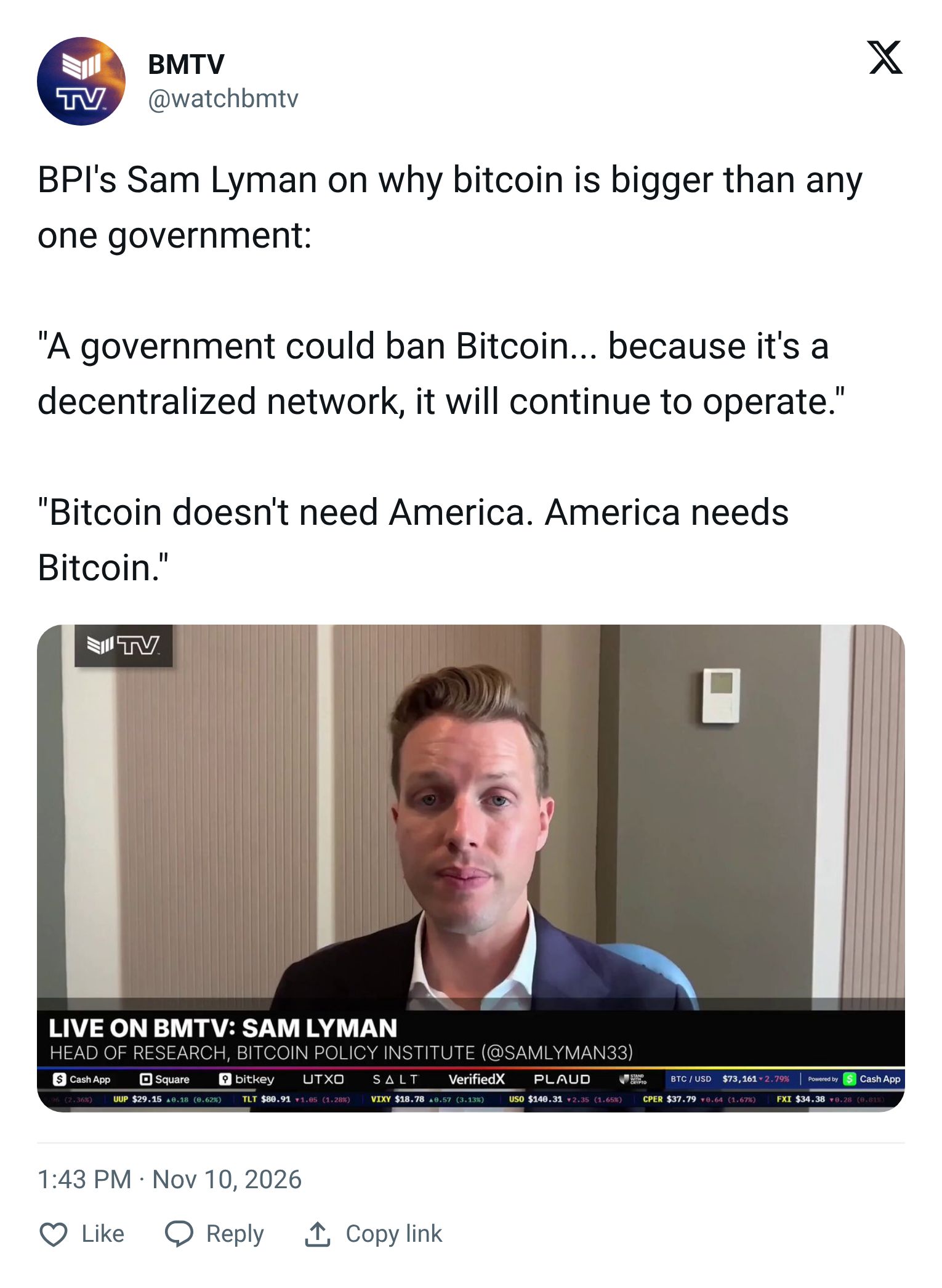
Bitcoin went through its own founder departure early. In his last known email, in April 2011, Satoshi Nakamoto told developer Mike Hearn he had "moved on to other things." Nobody convened a board or named an interim CEO. The rules kept running because they never depended on him.
A saver holding bitcoin carries no key-person risk. It might sound trivial, but it isn’t – this is part of what makes bitcoin such an incredible store of value. There is no chair to empty, and no successor to price in. Bitcoin is bigger than companies, nation states, and, in the not-too distant future, one could imagine it being greater than even one planet – being utilized as an interplanetary store of value.
NEWS
Treasury withdraws its $250 travel rule proposal
FinCEN and the Federal Reserve withdrew a 2020 proposal that would have cut the threshold for collecting and passing along customer information on transfers into or out of the U.S. from $3,000 to $250, and written crypto into the rule's definition of money. The $3,000 threshold stays, along with FinCEN's 2019 guidance that the rules can already apply to crypto transfers.

A 1995 number
The $3,000 threshold dates to a 1995 rule and was never indexed to inflation, so it already reaches far more ordinary transfers than it did then. For cross-border transfers, the proposal would have cut it by more than 90%.
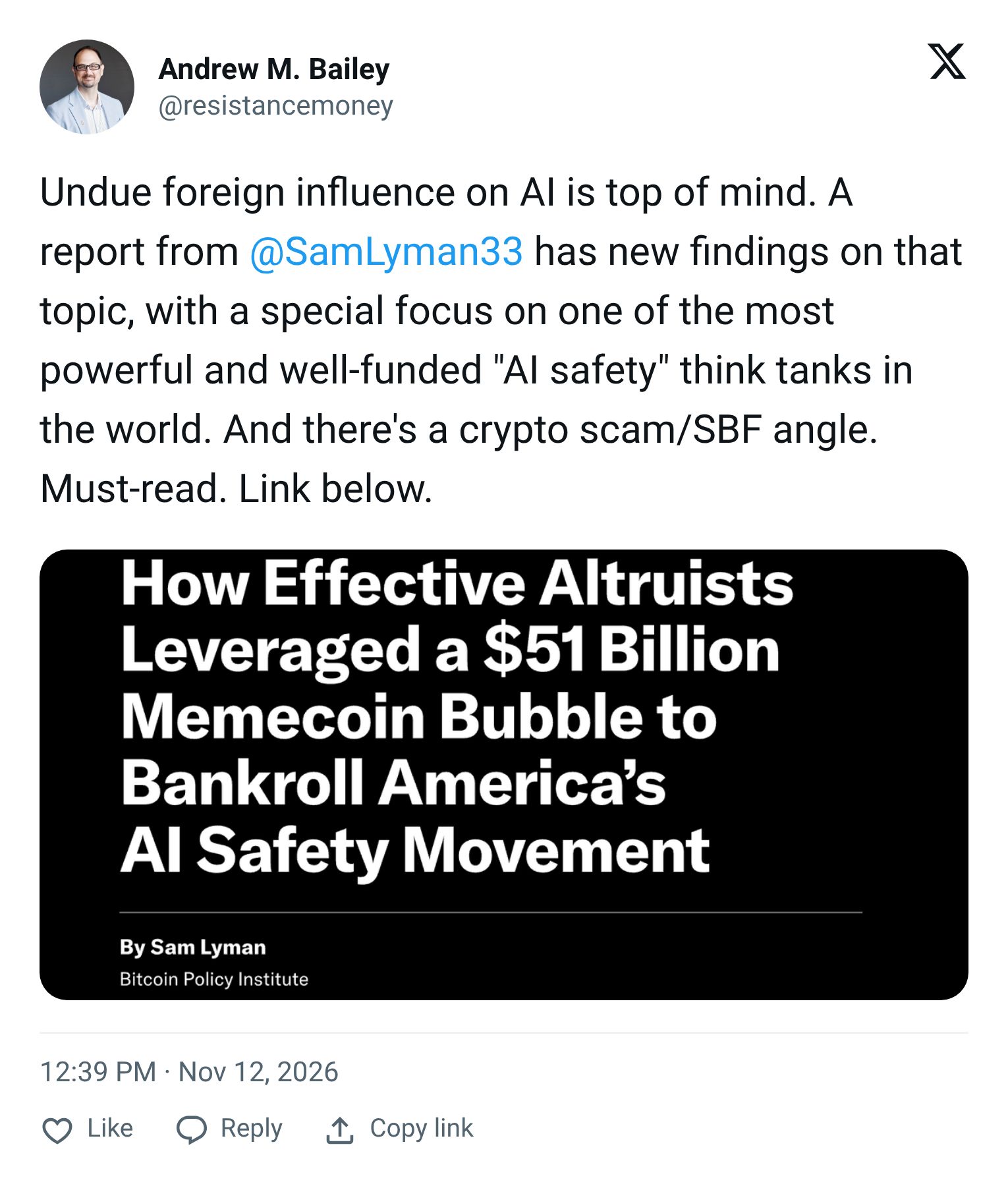
Bitcoin Policy Institute report traces an ai safety think tank's fortune to a memecoin gift
The Bitcoin Policy Institute published a report Thursday finding that about 94% of the Future of Life Institute's reported contributions over a decade came from one gift: Vitalik Buterin's May 2021 donation of Shiba Inu tokens, valued at $665.9 million. FLI converted the tokens through Sam Bankman-Fried's FTX, and Buterin has said it cashed out roughly $500 million.
Free tokens, paid for by someone else
SHIB's creators handed Buterin half the supply unasked to market him as its largest holder. The gift became cash only because later buyers paid up, and 85% of holders were underwater by December 2022. Every bitcoin in existence was mined.
MSCI will drop strategy from its indexes on nov. 30
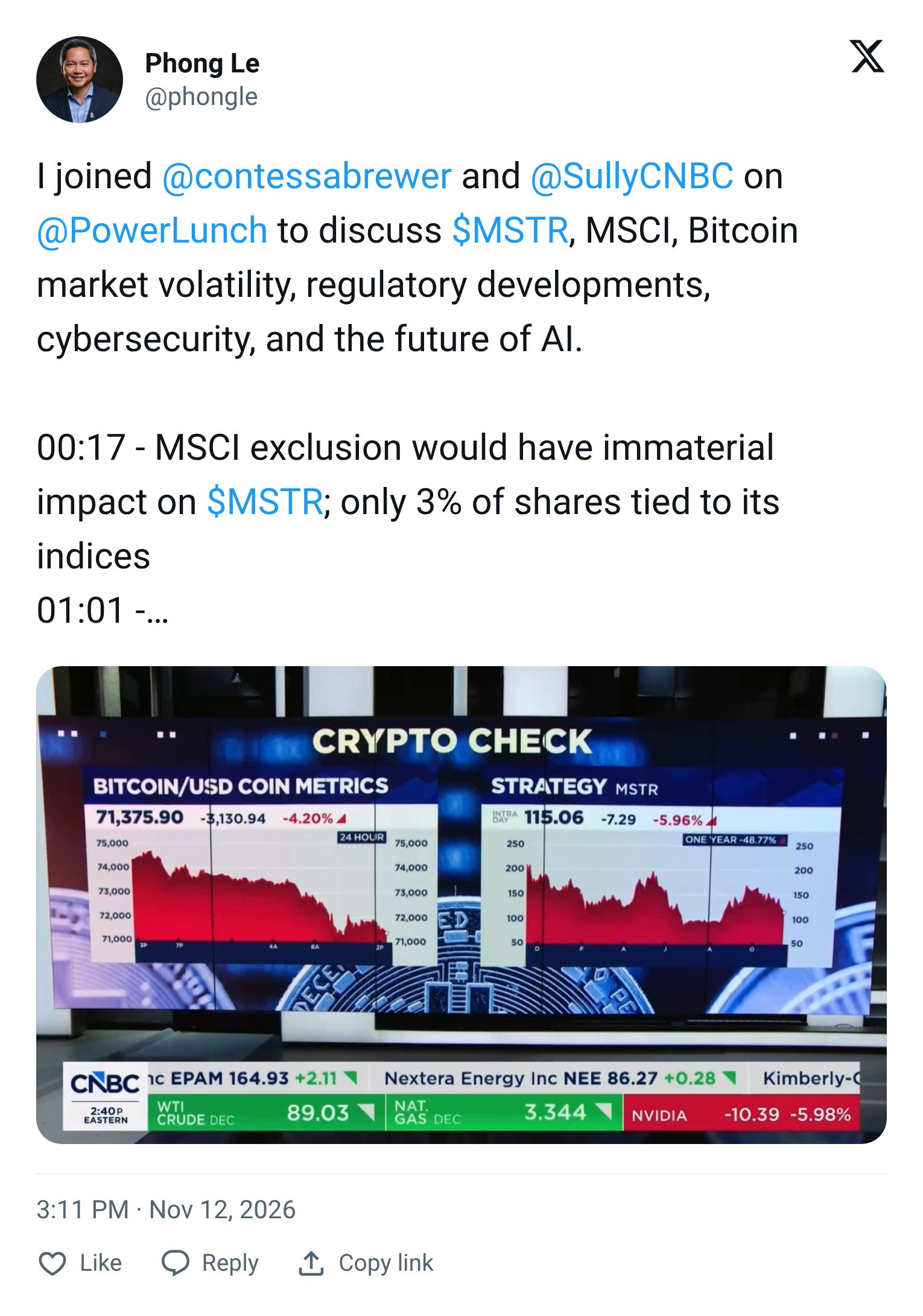
MSCI's November index review lists Strategy for deletion from its USA Index at the Nov. 30 close, which also takes it out of the MSCI World and ACWI benchmarks. A new rule treats companies whose assets are mostly investments as non-operating, and funds tracking those indexes must sell; JPMorgan estimated last year that exclusion could mean about $2.8 billion in outflows. Strategy President Phong Le claimed the rule would have little impact on MSTR:
A slower buyer…
Strategy pays for its bitcoin by selling its own stock, which is how it funded this week's 1,036-coin purchase. Regardless of the claims of Strategy executives, losing index funds as automatic buyers of that stock could slow the largest corporate buyer of bitcoin.
MARA sells 13,597 bitcoins and pays off its bitcoin-backed loans
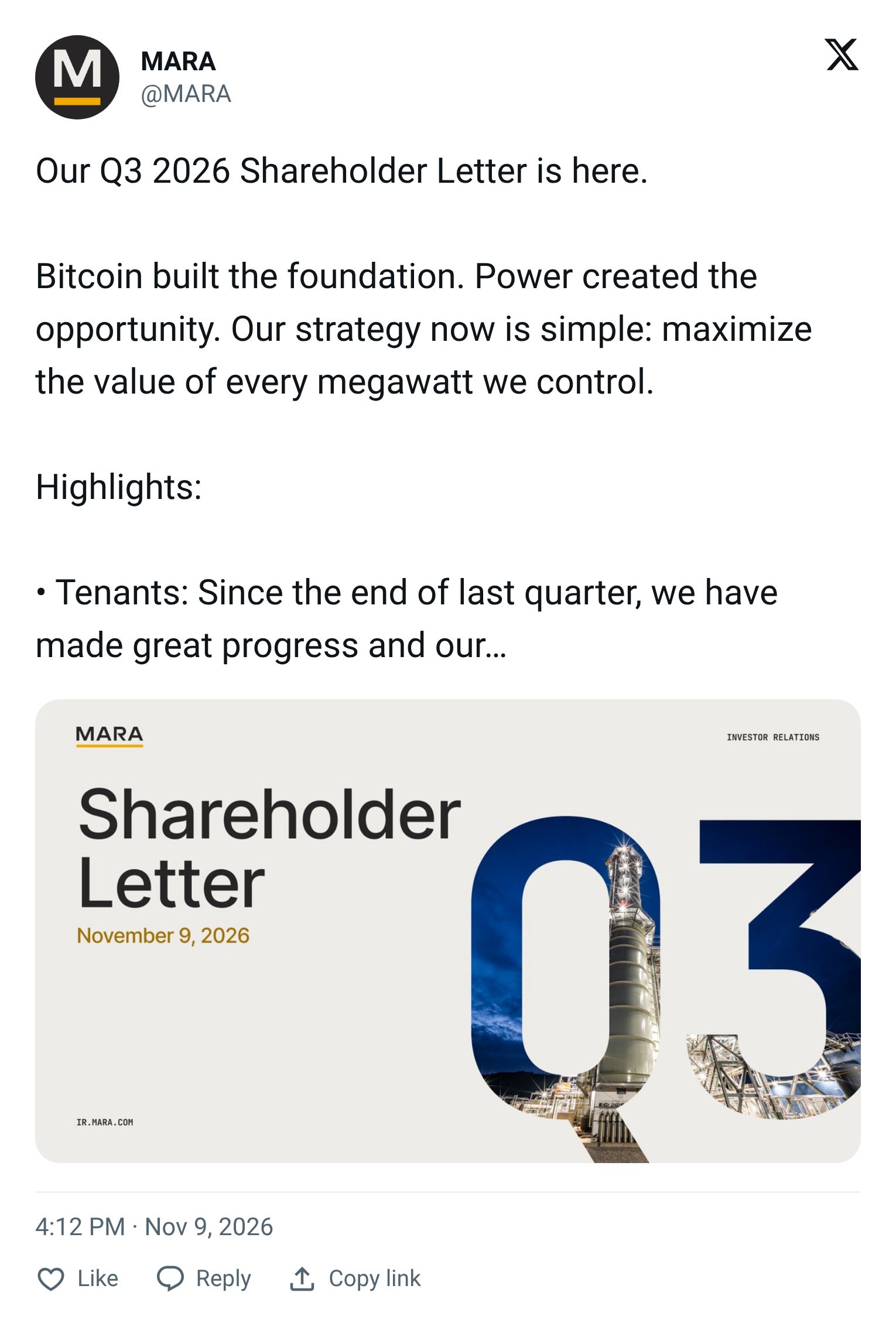
MARA said Monday that it sold 13,597 bitcoins after the third quarter for about $1.1 billion, roughly 40% of its holdings, and used $750 million to repay its bitcoin-backed term loans in full. The miner said it expects to keep selling to fund AI infrastructure and other obligations.
The miners are the sellers now
MARA sold about six times as many bitcoins in six weeks as it mined all third quarter. Miners used to be bitcoin's most natural holders; this year MARA and Riot account for more than half of what public companies have sold, per Lookonchain, mostly to fund AI buildouts.
BITCOIN ADOPTION CONTINUES
Deutsche Bank switched on its digital asset custody service for paying institutional and corporate clients in Europe, holding bitcoin alongside ether and three stablecoins.
Coinbase received final federal approval for Coinbase National Trust Company, which will take over its institutional custody business under OCC oversight.
Miami-Dade County's tax collector began accepting bitcoin for property taxes, online and in person, with each payment converted to dollars before it reaches the county.
Strategy disclosed an $81.9 million purchase of 1,036 bitcoins, bringing its holdings to 850,364 coins.
Trump Media reported adding a net 1,510 bitcoins in the third quarter, bringing its holdings to about 15,649, with most of them pledged to an options program or as collateral for its convertible notes.
Texas Rep. Ron Reynolds filed House Bill 815, which would let each Texas city and county invest up to $10 million in bitcoin starting in September 2027.
Onramp launched Onramp Business, a free company bitcoin account with named users and a second person required to approve withdrawals.
HOW BITCOIN WORKS
Learn one key idea about bitcoin each week. This week:
What is the debt ceiling?
The debt ceiling is a cap Congress sets on how much the Treasury can borrow in total. When the debt reaches it, the Treasury can't issue new debt until Congress raises or suspends the limit, even to pay for spending Congress has already approved.
In practice, Congress raises it. The limit has been changed 104 times since the end of World War II, 22 of them since 2001, according to the Congressional Research Service. Sometimes Congress sets a new dollar figure; lately it often suspends the limit for a set period instead. The most recent change, in July 2025, added $5 trillion and put the ceiling at $41.1 trillion.
That new ceiling is already close. Writing in The Daily Economy this week, AIER's David Hebert notes that federal debt is above $40 trillion and on pace to reach the limit in the first half of 2027. The government spent $1.05 trillion on interest in 2026, and Hebert estimates each one-point rise in yields eventually adds about $327 billion a year.
The limit was never designed as a brake. Until 1917, Hebert writes, Congress borrowed for specific projects like the Louisiana Purchase. The aggregate cap began during World War I as a way to approve borrowing faster.
So the debt ceiling doesn't stop borrowing. It schedules a vote on it, and the vote has gone the same way every time.
Bitcoin's 21 million limit works differently. It is enforced by the software every node runs, and there is no vote to schedule.
COIN CHECK
The Office of the Comptroller of the Currency, which still charters national banks today, was created by an 1863 law. Which president signed it?
A. Andrew Jackson
B. Abraham Lincoln
C. Ulysses S. Grant
D. Woodrow Wilson
Check your answer at the end of the page.
ANSWER
Answer: B. Abraham Lincoln signed the National Currency Act on Feb. 25, 1863, creating a system of nationally chartered banks and the Office of the Comptroller of the Currency to supervise it, in part to help finance the Civil War.
That’s all for this week, folks! When you signed up for this newsletter, we promised to act as your personal guide and help you understand what’s happening in the world of bitcoin. What did you think of today’s newsletter? Reply to this email and let us know what you’d like to see more of.
Until next week!
What did you think of this edition of Bitcoin Roundup?
Was this email forwarded to you? Sign up here.
